
How to become a grower
Become a mushroom seller first
Before investing a significant amount of money in the construction of production facilities, it is advisable to examine or develop the market in your region. Once you know which mushrooms you can sell in your region, in what quantities and at what price, it will be much easier to plan your production.

Little effort, low risk
To do this, you can buy and resell mushrooms and cooperate with producers in the region. It does not always make sense to grow all mushrooms yourself. With smart cooperation, you can expand your own range with little effort and low risk, because the more diverse you want to make your mushroom range through your own production, the higher the effort and the more complicated the production. ESSMI is a good network for finding farms nearby with whom you can build cooperation.
Quantities throughout the year
It is important to know that mushroom demand is not stable. It fluctuates greatly throughout the year. While demand is very high before Easter and especially before Christmas, it declines sharply in summer with the start of the strawberry and asparagus season and only recovers in autumn. The decline in sales can be as much as 70% in summer.
There are two main ways of selling:
- Selling to wholesalers or retailers
- Direct marketing

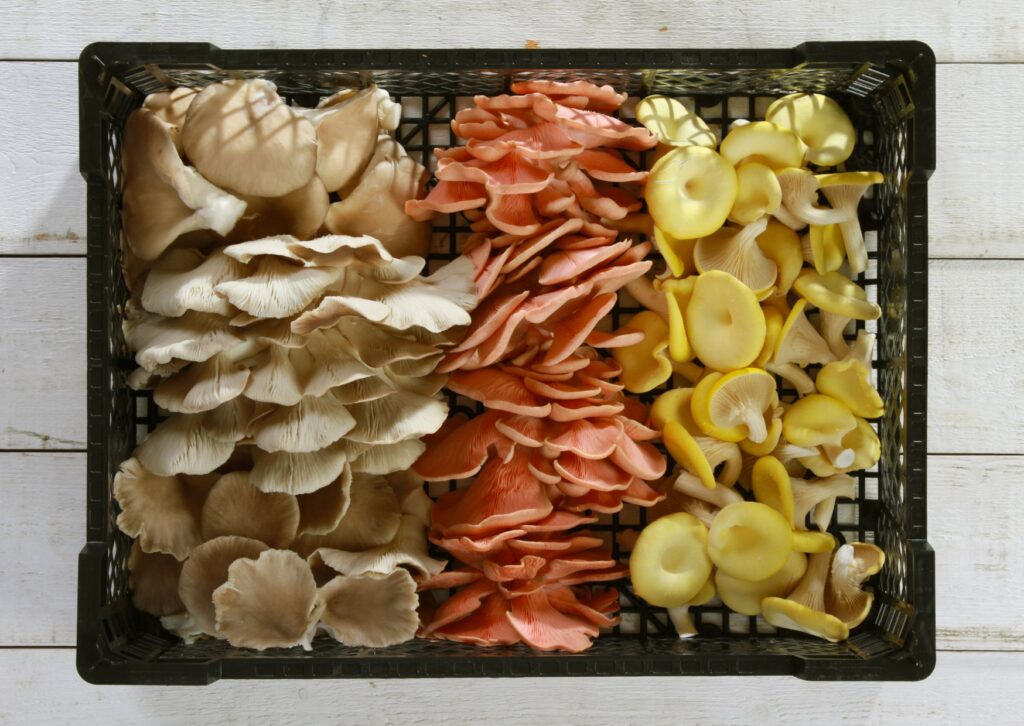

1. Selling to wholesalers and distributors
Selling to wholesalers and distributors can be a viable option if your business consistently produces at least 1,000–2,000 kg of mushrooms per week. At these volumes, however, the prices offered by wholesalers tend to be lower, making high production essential to profitability. The key benefit—and simultaneous challenge—of this model is the need to reliably supply large quantities throughout the entire year.
Entering the wholesale market also requires a well-thought-out strategy. It’s important to avoid becoming overly dependent on a few buyers, as this can lead to pricing pressure. Additionally, keep in mind that packaging and labeling standards in this segment are typically more demanding.
2. Direct marketing
Depending on the region, direct marketing is typically feasible for up to around 500 kg of mushrooms per week. In less developed markets, however, the realistic upper limit is often closer to 100 kg per week.
The main advantage of direct marketing is the ability to command significantly higher prices, with lower requirements for packaging and labeling. However, this approach also involves greater personal effort and limits your overall market reach.
The following direct marketing channels are available
- Farm shop
- Weekly market
- Online sales
Supplying restaurants can allow for the sale of larger quantities, depending on the regional economic structure. However, consistent, on-time delivery of the required volumes in high quality is essential to succeed in this channel.
Another valuable sales avenue is through cooperation and regional networks. This can include partnerships with vegetable farmers, contributing mushrooms to organic box subscriptions, or joining farm cooperatives and producer associations to expand reach and streamline distribution.
Be creative, build a strong local network and brand, be dependable and live a happy mushroom life!